Tag: Emissions Test

Maryland – Emissions Failures and Retests

Last updated on November 9th, 2017

There is a chance that your vehicle may have failed the Maryland emissions inspection test.  In the event of Vehicle Emissions Failures there are a few possibilities that caused this and there are certain steps you now must follow.

Your vehicle could have failed the test for the following reasons: Your vehicle has exceeded the standards for hydrocarbon resulting in a hydrocarbon failure.  Your vehicle has exceeded the standards for carbon monoxide resulting in carbon monoxide failure.  There could have been a sample dilution failure.  Your vehicle could have failed the On Board Diagnostics test.  Your vehicle could have missing, disconnected, or broken emissions control equipment.  Or your vehicle could have had a gas cap failure resulting in vapors leaking from your vehicle.

If your vehicle failed the Maryland emissions test your next step is to have the vehicle repaired to correct whatever failure(s) have occurred.  After your vehicle is repaired you need to get your vehicle retested.  When you go to get your emissions retest you should bring along your initial test results paper that you were given, along with the paperwork from the garage/service center that repaired your vehicle’s emissions issues.   The first retest of your vehicle is free.

If you spent $450 or more on your emissions related vehicle repairs you may be eligible to get a Maryland emissions waiver.  If you would like to apply for the waiver you must complete the backside of the vehicle inspection report paper you were given after your vehicle was initially tested.  You must also submit the receipts for the work you had done on your vehicle.

If you fail the retest your second retest you will need to pay for.

If you have any questions you can contact the emissions inspection program at 1-800-638-8347.  If you have questions for the MVA the customer service contact number is 1-800-950-1682.


Filed under: Maryland, Articles, State Emissions TestingTagged with: , ,

Connecticut – Failures and Retests

Last updated on November 16th, 2017

There is a chance that your vehicle may not pass its Connecticut Vehicle Emissions test.  If your vehicle did not pass the test it is because your vehicle is not running correctly and it is creating pollution in the air.  It is a fact that over 40% of air pollution in Connecticut is the result of cars, trucks, and other vehicles.  The goal of the emissions testing is to limit as much pollution as possible by catching those vehicles that emit more pollution than they should be and having them fix the issue.

If your vehicle did not pass it emissions test you will have sixty days from the date of the test that your vehicle failed in order to have the problems that were found fixed and get a second emissions test.  The second test, the retest, is free.  You can get the retest done at any location, it does not need to be at the same service center.  If you wait longer than the sixty days in order to get your retest, the retest will not be free and you will need to pay the $20 test fee for the second test.

If you cannot afford the repairs needed for your vehicle you can apply for an economic hardship waiver.  To do this you must follow these steps:

– You must complete documentation and provide it to the DMV that shows your annual income is at or below the state and federal poverty level guidelines.

– You must state that you have no other assets that you could use to pay for the vehicle repairs.

– And if you then receive the economic hardship waiver your vehicle MUST pass its next emissions test in order to become eligible for this waiver in the future.

If you bring your vehicle to a repair shop and that shop runs a diagnostic test on your vehicle and determines that there is nothing that needs to be repaired you can apply for a diagnostic waiver.   To do this your vehicle will need to be brought to DMV to have a full diagnostic test performed.  If the DMV runs the test and agrees that no work is needed you will be given the waiver.  To apply for this waiver you should get in contact with your Department of Motor Vehicles.


Filed under: Connecticut, Articles, State Emissions TestingTagged with: ,

Maine – Emissions Testing Hours & Schedule

Last updated on November 15th, 2017

Maine – Emissions Testing Hours Schedule – The state of Maine allows privately owned dealerships, auto repairs shops, and auto tech shops to perform emissions testing on vehicles.  Here is a list of emissions testing locations in Maine.  Because each location is unique there are no set hours or schedule to have your emissions tested in Maine.  It is recommended that you call the location you plan on attending ahead of time to check their hours, schedule, wait times, and if they accept appointments.

Emissions.org will give you a comprehensive information on all the relevant contacts. Browse the States and their Counties to find the information you need.

Filed under: Articles, Maine, State Emissions TestingTagged with: ,

Massachusetts – General Emissions Information

Last updated on March 4th, 2021

Massachusetts – General Emissions Information – The state of Massachusetts requires emissions testing on most vehicles and there are many common questions that vehicles owners in Massachusetts have concerning the emissions testing program.  This section will cover some of the most frequently asked questions about the Massachusetts emissions inspection program and provide the answers to these questions.

Does every vehicle need to be tested for emissions in Massachusetts?

There are certain vehicles which are not intended to be driven on the roads in Massachusetts and these vehicles do not require an emissions test.  These vehicles would be:  ATVs, Loaders & Haulers, Backhoes, Bulldozers, Cranes, Excavators, Platform Lifters, Motor Graders, Pavers, Tractors and farming equipment, and Tracked Vehicles.

How often do I need to have my vehicle’s emissions tested in Massachusetts?

In Massachusetts your must have your vehicle’s emissions tested every year before the current inspection sticker expires.

What if I purchased a new or used car, do I need to have the emissions tested?

Yes, you must get your vehicle’s emissions inspection done within seven calendar days from the date you get the registration.

Is there a customer service number to speak to someone about the Massachusetts emissions inspection program if I cannot find the answer to my question online?

There is a Motorist Hotline 1-866-941-6277 for Massachusetts motorists.  There is also the Auto Safety Hotline at 1-888-327-4236

Is there a fee to get my emissions tested?

Yes, there is a $29 fee which you need to bring with you (along with your registration) when you bring your vehicle in for emissions testing.

What happens after the emissions test is complete?

After your emissions testing is complete there will be a sticker printed out for your vehicle and you will also get a copy of the vehicle inspection test results.  This report will tell you if your car passed or failed the test, and if your vehicle had issues it will direct you as to what the failing area was.

If I’m required to get a federal DOT inspection do I need to do this and get the vehicle’s emissions tested?

No, if you get your Massachusetts emissions inspection done this will allow you to meet the federal DOT requirement.  The paperwork you receive after you pass the emissions inspection is proof that can be used to signify you met the DOT requirements.

Filed under: Massachusets, Articles, State Emissions TestingTagged with: ,

Mississippi Car Insurance

Last updated on April 26th, 2018

Mississippi Car Insurance – The state of Mississippi has had compulsory car insurance in some form or another since the 1950’s. Despite over 60 years of requiring residents to maintain car insurance on their vehicles, Mississippi has the second worst uninsured motorists rate in the country, behind only New Mexico. As of 2012, the uninsured motorist rate for the state of Mississippi was an astounding 28 percent, twice the national average, underscoring a problem the state has had with car insurance enforcement for the last decade. As recently as February 2012 state lawmakers have attempted to get uninsured motorists under control by proposing new laws that would aid in the enforcement of Mississippi car insurance regulations.  Introduced in 2012, House Bill 480 will require all vehicles to have proof of insurance before they can be registered with the DMV. If passed the bill will also create a database of all vehicles registered in Mississippi and their current insurance status which will e used by law enforcement officers to instantly check if a vehicle has insurance during any traffic stop or after an accident. The database system is in use by many states and has proven to be quite effective, especially in Georgia and Wyoming, and because it is linked directly to insurance companies the insurance status of a vehicle would be updated instantaneously. If it is signed into law House Bill 480 will also establish a series of fines intended to penalize drivers that are caught driving uninsured. The proposed fines would cost a driver $300 for a first offense, $400 for a second offense and $500 for a third offense.

Although Mississippi has a high rate of uninsured drivers, car insurance is still required by state law, even if the methods of enforcement have not yet been put entirely in place. According to Mississippi, car insurance law drivers must obtain minimum levels of liability insurance on a vehicle before they can take it on a public road. These minimums are currently set at $25,000 per person and $50,000 per accident in bodily injury liability insurance as well as $25,000 in property damage coverage. If a Mississippi resident does not want to purchase an auto insurance policy that meets these minimum levels of coverage set by the state they always have the option to post a bond or make a deposit in cash or securities with the state. A bond or deposit made with the state in lieu of purchasing a car insurance policy must be in the same amount as the combined total of bodily injury and property damage insurance required by the state. In addition to required liability coverage, when purchasing a policy in Mississippi drivers also have the option to voluntarily purchase a variety of other types of insurance coverage for their vehicle. One of the most common types of coverage that Mississippi motorists add to their car insurance policies is collision coverage. Collision coverage will pay for any damages to the insured vehicle should it be involved in an accident in which the driver of the insured vehicle is at fault. If the driver of the insured vehicle is not at fault the at-fault driver’s property damage coverage will pay for any damage. Comprehensive coverage is also popular with many drivers because it covers all sorts of damage to a vehicle not caused by another car, such as hail or debris on the road. Drivers also have the option of purchasing personal injury protection which will cover any medical payments as well as lost wages that result from injuries sustained in a car accident that was not the policy holder’s fault. Because Mississippi requires liability coverage and other forms of coverage are available to driver there is not much need for uninsured or underinsured motorist coverage in the state.

Until House Bill 480 passes the penalty for driving without insurance in Mississippi will remain the same as it was ten years ago. If a driver is pulled over for a traffic violation or involved in an accident they may be required to provide proof of insurance to law enforcement. If this proof cannot be provided the uninsured drive could face a fine as high as $1,000 and the registration of the vehicle could be suspended for up to 1 year. If the driver can provide proof of insurance or some other proof of financial responsibility at the time of their court hearing they could have their fine reduced and be permitted to reinstate their registration. Although these penalties are considered adequate the establishment of a complete database that can be consulted by law enforcement officers any time and anywhere should greatly increase the enforcement of current Mississippi car insurance laws. Such a database would allow an officer to know before he even pulls a vehicle over whether or not the vehicle meets the state’s financial responsibility requirements.

Find Smog Check Stations Near Me

Even though Mississippi drivers are not required to pass any smog check requirements, Mississippi-registered drivers can get a voluntary vehicle emissions test done. Check out our DMV & Emissions Testing Locations in Mississippi pages below to find a DMV office or testing location in your area.

Filed under: Mississippi, Articles, Car InsuranceTagged with: , , ,

Illinois – Emissions Testing Hours & Schedule

Last updated on March 4th, 2021

For the state of Illinois, it is required that the emissions test is carried out every two years. The cars that must be tested are the cars build four years ago or older than that. The two-year inspection must be done before the registration renewal is due. Due to this two year rule, even model years are tested on the even year and odd model years take emissions test on odd years. You also need to check the other state of Illinois regulations and requirements for emissions testing.

The state will send you a notice stating that your car is due for the emissions test. You will need to bring this notice with you for the testing. In order for the car to be eligible for registration renewal, it must successfully pass the Illinois emissions testing. If your car is due for the test, you’ll need to first find the nearest Illinois emissions testing station. To find a location near you, click here.

Illinois emissions testing stations hours

Once you’ve selected your location, you’ll then need to check emissions testing stations hours and availability. Illinois emissions testing stations hours can vary depending upon the location of the service center at which you are going to do your emissions test. For example, emissions testing hours in Naperville are 8:00 AM–6:00 PM, while for some stations for emissions testing hours in Skokie are 9:00 AM – 5:00 PM. On Saturdays, most vehicle emissions testing stations work from 7:30 AM to 1:00 PM. Make sure you get the right information by contacting the emissions test location prior to visiting. You can find the nearest station by visiting the locations page for your county. Make sure that your chosen date is not Sunday or a Federal Holiday since most Illinois emissions testing stations are closed on these dates. You can check the dates of Federal Holidays in the table below.

Federal Holidays are:

Holiday 2017 2018
New Year’s Day Monday, January 2 Monday, January 1
Martin Luther King Day Monday, January 16 Monday, January 15
Lincoln’s Birthday Monday, February 13 Monday, February 12
Washington’s Birthday
(President’s Day)
Monday, February 20 Monday, February 19
Memorial Day Monday, May 29 Monday, May 28
Independence Day Tuesday, July 4 Wednesday, July 4
Labor Day Monday, September 4 Monday, September 3
Columbus Day Monday, October 9 Monday, October 8
General Election Day Tuesday, November 6
Veterans’ Day Friday, November 10 Monday, November 12
Thanksgiving Thursday and Friday
November 23 and 24
Thursday and Friday
November 22 and 23
Christmas Monday, December 25 Tuesday, December 25

*Please note that the holidays can change since the state is continuously negotiating with various unions.

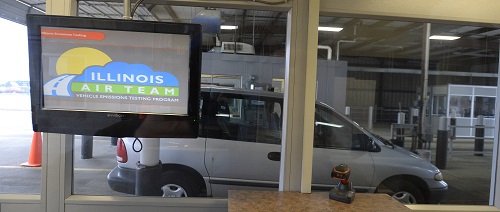
Illinois Air Team Car Emissions Testing

If you are going to have your car tested by the Air Team appointment only testing station, you can call to set up an appointment. The number to speak with a representative is (844) 258-9071. You can also call to find out how long the current waiting times are for the emissions testing centers.

Illinois emissions testing stations schedule

It is best if you book an emissions testing appointment in advance, but if you cannot do that, it’s good to know the schedule and the time it takes to take the emissions test. If you can, avoid going for a test at the beginning and the end of the month, or on Saturdays. These are the busiest times for most emissions testing locations in Illinois. It should be easy to schedule a timely visit to emissions testing center of your choice since you’ll have four months to take your vehicle in for the test prior to the registration expiry. The wait times can also vary depending on the location. Wait time for emissions testing in Swansea area is usually around one, while for some locations, like Markham emissions testing center, the wait time can be nine. Check all the available information at your disposal, so that you don’t have to waste time waiting in line at the emissions testing location.

Shorten the wait time for others

Chicago Emissions Testing

You can help shorten the emissions test wait times for other motorists if you come prepared for the testing. This, of course, means preparing your car so that the test can be done quickly. You need to make sure that the car engine is warmed up properly, that the car is safe to operate and that there is nothing obstructing the access to the DLC unit of your car. You can also read some tips that may help you pass the emissions testing safely.

Filed under: Illinois, Articles, State Emissions TestingTagged with: , ,

Arizona – Emissions Testing Locations

Last updated on November 20th, 2017

Arizona Emissions Testing Locations – There are emissions testing facilities in Arizona in the Phoenix and Tuscon areas.  The station locations are as follows:

10210 N. 23rd Ave., Phoenix, AZ 85021
1301 S. Stocker Dr., Tucson, AZ 85710
13425 W. Westgate Dr., Surprise, AZ 85374
1520 E. Riverview Dr., Phoenix, AZ 85036
16140 W. Eddie Albert Way in Goodyear
1851 W. 1st Ave., Mesa, AZ 85202
20 N. Beck Ave., Chandler, AZ 85226
2360 S. Airport Blvd., Chandler, AZ 85286
3931 N. Business Center Dr., Tucson, AZ 85705
4442 E. Ivy St., Mesa, AZ 85205
4949 E. Madison, Phoenix, AZ 85034
501 W. Deer Valley Road in Phoenix
5302 W. Roosevelt, Phoenix, AZ 85043
565 E. 38th Avenue in Apache Junction
5850 W. Beverly Ln., Glendale, AZ 85306
6661 S. Renaissance Dr., Tucson, AZ 85746
7140 N. 110th Ave., Glendale, AZ 85307
8448 E. Evans, Scottsdale, AZ 85260

All Arizona emissions testing stations follow the testing hours and schedule listed on the hours page found here.

Filed under: Arizona, Articles, State Emissions TestingTagged with: ,

Connecticut – Emissions Testing Hours Schedule

Last updated on April 26th, 2018

Connecticut – Emissions Testing Hours Schedule – The state of Connecticut Vehicle Emissions Testing program has certain testing hours and a testing schedule that you should be aware of prior to to getting your car tested.  The vehicle emissions testing official hours are Monday – Friday from 8:00 a.m. until 5:00 p.m. and on Saturday from 8:00 a.m. until 1:00 p.m.   It is recommended that you call the testing center ahead of driving there to ensure they are open.

Holidays and non working days

The vehicle emissions testing program is closed on certain holidays each year.  These holidays are New Year’s Day, Memorial Day, Independence Day, Labor Day, Thanksgiving Day, and Christmas Day.  You should plan your vehicle emissions testing date accordingly.

Filed under: Connecticut, Articles, State Emissions TestingTagged with: ,

Delaware – General Emissions Information

Last updated on March 4th, 2021

Delaware General Emissions Information – The state of Delaware requires emissions testing on vehicles of Delaware residents.  There are many common questions that residents have about the Delaware emissions testing program and this section will look at some of the most frequently asked questions and their corresponding answers.

Can I apply for a waiver and if so, how?

There are certain criteria that must be met in order for a resident to apply for a waiver in regards to their vehicle’s emissions test.  Waivers are granted not to excuse a vehicle from an initial test, but for vehicles that have failed multiple tests even after repairs have been made on the vehicle to fix the issue found during the emissions inspection period.  In order to receive a waiver the following conditions must be met:

1.  Your vehicle must have failed the emissions inspection at least 2 times or more.

2.  The parameters of your vehicle’s engine are set to the specifications determined by the vehicle’s manufacturer.

3.  You have spent above a set limit in repairs on the vehicle in regards to items repaired specifically for emissions purposes.  If your vehicle is from 1981 or newer the threshold that must be reached is $810 in repairs.  Vehicles manufactured prior to 1981 have a threshold of $75 in repairs.

4.  The reasons for the emissions inspection failure was not due to visible smoke or missions emissions control equipment.

When you present the waiver application to the DMV you must have all the receipts for the repairs you had done along with the vehicle inspection reports from your failed emissions tests.

Who sets the emissions standards for exhaust levels?

This exhaust levels set for the emissions inspection are set by the Department of Natural Resources and Environmental Control.

How much does emissions testing cost?

In the state of Delaware, residents get their vehicle’s emissions tested for free.

How often do I need to get my vehicle’s emissions tested?

Vehicles are required to get their emissions tested once every two years.  You must get your emissions tested before you are able to renew your vehicle’s registration.

How will I know if I need to get my emissions tested?

The DMV will send you a registration renewal notice about ninety days prior to when your current registration will expire.  At this point you should begin to consider getting your emissions tested.

Filed under: Delaware, Articles, State Emissions TestingTagged with: ,

What You Need to Know About Your Check Engine Light

Last updated on March 4th, 2021

Check Engine Light – The state of Colorado requires emissions testing on most vehicles in the state. But did you know that if your check engine light comes on, it could mean that your vehicle is no longer safe on the environment?

We all know that when our check engine light comes on, it means that our vehicle needs some sort of maintenance, it can be something simple, or something more serious. The problem is, most people don’t realize that when you drive your vehicle while the light is on, you are exposing the air to dangerous toxins.

Your vehicle is no longer in good standing with emissions laws, because there is something wrong with the vehicle. It’s also dangerous to drive a vehicle while the light is on because something could go wrong while driving, resulting in an accident. You should have your vehicle checked before driving it again once the engine light comes on.

It’s usually something simple, like a loose gas cap, or its time to replace spark plugs. Don’t be afraid when your check engine light comes on, it’s usually something cheap and easy to repair. So the next time your check engine light comes on, keep in mind that you could be polluting the air around you, and that not only effects you, but the people around you.

Filed under: Colorado, Articles, State Emissions TestingTagged with: ,